in what era did composers begin to be recognized
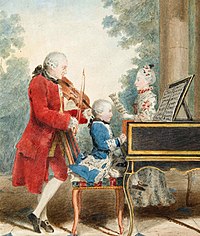
The Classical period was an era of classical music betwixt roughly 1730 and 1820.[1]
The Classical menstruum falls between the Bizarre and the Romantic periods. Classical music has a lighter, clearer texture than Baroque music, merely a more than sophisticated use of grade. Information technology is mainly homophonic, using a articulate melody line over a subordinate chordal accompaniment,[2] but counterpoint was by no means forgotten, especially in liturgical vocal music and, afterwards in the menstruation, secular instrumental music. It likewise makes utilise of manner galant which emphasized light elegance in place of the Baroque's dignified seriousness and impressive grandeur. Diverseness and dissimilarity inside a slice became more than pronounced than earlier and the orchestra increased in size, range, and power.
The harpsichord was replaced as the main keyboard instrument by the piano (or fortepiano). Unlike the harpsichord, which plucks strings with quills, pianos strike the strings with leather-covered hammers when the keys are pressed, which enables the performer to play louder or softer (hence the original proper noun "fortepiano," literally "loud soft") and play with more than expression; in dissimilarity, the force with which a performer plays the harpsichord keys does not change the sound. Instrumental music was considered important by Classical menstruation composers. The main kinds of instrumental music were the sonata, trio, string quartet, quintet, symphony (performed by an orchestra) and the solo concerto, which featured a virtuoso solo performer playing a solo piece of work for violin, piano, flute, or another instrument, accompanied by an orchestra. Vocal music, such equally songs for a singer and piano (notably the work of Schubert), choral works, and opera (a staged dramatic piece of work for singers and orchestra) were likewise of import during this period.
The all-time-known composers from this menstruation are Joseph Haydn, Wolfgang Amadeus Mozart, Ludwig van Beethoven, and Franz Schubert; other notable names include Carl Philipp Emanuel Bach, Johann Christian Bach, Luigi Boccherini, Domenico Cimarosa, Joseph Martin Kraus, Muzio Clementi, Christoph Willibald Gluck, Carl Ditters von Dittersdorf, André Grétry, Pierre-Alexandre Monsigny, Leopold Mozart, Michael Haydn, Giovanni Paisiello, Johann Baptist Wanhal, François-André Danican Philidor, Niccolò Piccinni, Antonio Salieri, Georg Christoph Wagenseil, Georg Matthias Monn, Johann Gottlieb Graun, Carl Heinrich Graun, Franz Benda, Georg Anton Benda, Johann Georg Albrechtsberger, Mauro Giuliani, Christian Cannabich and the Chevalier de Saint-Georges. Beethoven is regarded either equally a Romantic composer or a Classical period composer who was part of the transition to the Romantic era. Schubert is as well a transitional figure, equally were Johann Nepomuk Hummel, Luigi Cherubini, Gaspare Spontini, Gioachino Rossini, Carl Maria von Weber, Jan Ladislav Dussek and Niccolò Paganini. The flow is sometimes referred to as the era of Viennese Classicism (German: Wiener Klassik), since Gluck, Haydn, Salieri, Mozart, Beethoven, and Schubert all worked in Vienna.
Classicism [edit]
In the middle of the 18th century, Europe began to move toward a new style in architecture, literature, and the arts, generally known equally Classicism. This style sought to emulate the ideals of Classical antiquity, especially those of Classical Greece.[three] Classical music used formality and accent on order and hierarchy, and a "clearer", "cleaner" style that used clearer divisions between parts (notably a clear, single melody accompanied by chords), brighter contrasts and "tone colors" (achieved by the employ of dynamic changes and modulations to more keys). In contrast with the richly layered music of the Baroque era, Classical music moved towards simplicity rather than complexity. In addition, the typical size of orchestras began to increase,[iii] giving orchestras a more powerful sound.
The remarkable development of ideas in "natural philosophy" had already established itself in the public consciousness. In particular, Newton'southward physics was taken as a paradigm: structures should exist well-founded in axioms and be both well-articulated and orderly. This taste for structural clarity began to affect music, which moved away from the layered polyphony of the Baroque flow toward a way known as homophony, in which the melody is played over a subordinate harmony.[three] This motion meant that chords became a much more than prevalent feature of music, even if they interrupted the melodic smoothness of a unmarried part. As a result, the tonal structure of a piece of music became more audible.
The new style was also encouraged by changes in the economical lodge and social structure. Equally the 18th century progressed, the nobility became the primary patrons of instrumental music, while public taste increasingly preferred lighter, funny comic operas. This led to changes in the style music was performed, the most crucial of which was the movement to standard instrumental groups and the reduction in the importance of the continuo—the rhythmic and harmonic background of a slice of music, typically played by a keyboard (harpsichord or organ) and usually accompanied by a varied group of bass instruments, including cello, double bass, bass viol, and theorbo. I way to trace the decline of the continuo and its figured chords is to examine the disappearance of the term obbligato, pregnant a mandatory instrumental role in a work of chamber music. In Baroque compositions, additional instruments could be added to the continuo group co-ordinate to the grouping or leader's preference; in Classical compositions, all parts were specifically noted, though not always notated, then the term "obbligato" became redundant. By 1800, basso continuo was practically extinct, except for the occasional employ of a pipe organ continuo part in a religious Mass in the early 1800s.
Economic changes too had the effect of altering the rest of availability and quality of musicians. While in the late Baroque, a major composer would take the entire musical resources of a town to draw on, the musical forces available at an aristocratic hunting order or small courtroom were smaller and more fixed in their level of power. This was a spur to having simpler parts for ensemble musicians to play, and in the example of a resident virtuoso group, a spur to writing spectacular, idiomatic parts for certain instruments, equally in the case of the Mannheim orchestra, or virtuoso solo parts for particularly skilled violinists or flautists. In addition, the appetite by audiences for a continual supply of new music carried over from the Baroque. This meant that works had to be performable with, at best, one or two rehearsals. Even after 1790 Mozart writes about "the rehearsal", with the implication that his concerts would have only 1 rehearsal.
Since there was a greater emphasis on a single melodic line, there was greater accent on notating that line for dynamics and phrasing. This contrasts with the Bizarre era, when melodies were typically written with no dynamics, phrasing marks or ornaments, as information technology was assumed that the performer would improvise these elements on the spot. In the Classical era, information technology became more than mutual for composers to indicate where they wanted performers to play ornaments such as trills or turns. The simplification of texture fabricated such instrumental detail more important, and too made the use of characteristic rhythms, such as attending-getting opening fanfares, the funeral march rhythm, or the minuet genre, more important in establishing and unifying the tone of a unmarried motion.
The Classical period likewise saw the gradual evolution of sonata form, a set of structural principles for music that reconciled the Classical preference for melodic material with harmonic development, which could be practical beyond musical genres. The sonata itself continued to be the principal form for solo and chamber music, while afterward in the Classical menses the string quartet became a prominent genre. The symphony form for orchestra was created in this menses (this is popularly attributed to Joseph Haydn). The concerto grosso (a concerto for more than than one musician), a very pop form in the Bizarre era, began to be replaced by the solo concerto, featuring but one soloist. Composers began to place more importance on the particular soloist'south power to show off virtuoso skills, with challenging, fast scale and arpeggio runs. Nonetheless, some concerti grossi remained, the almost famous of which being Mozart'south Sinfonia Concertante for Violin and Viola in E-apartment major.
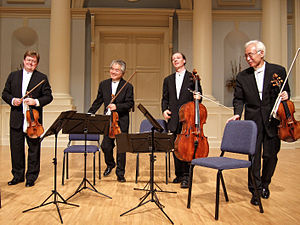
A modern string quartet. In the 2000s, string quartets from the Classical era are the core of the sleeping accommodation music literature. From left to right: violin i, violin 2, cello, viola
Main characteristics [edit]
In the classical menstruation, the theme consists of phrases with contrasting melodic figures and rhythms. These phrases are relatively cursory, typically four bars in length, and can occasionally seem thin or terse. The texture is mainly homophonic,[2] with a clear tune above a subordinate chordal accompaniment, for instance an Alberti bass. This contrasts with the practice in Baroque music, where a piece or movement would typically take only one musical subject field, which would then be worked out in a number of voices according to the principles of counterpoint, while maintaining a consistent rhythm or metre throughout. As a result, Classical music tends to take a lighter, clearer texture than the Baroque. The classical style draws on the manner galant, a musical manner which emphasised light elegance in place of the Bizarre's dignified seriousness and impressive grandeur.
Structurally, Classical music generally has a articulate musical class, with a well-divers contrast betwixt tonic and dominant, introduced by clear cadences. Dynamics are used to highlight the structural characteristics of the piece. In particular, sonata form and its variants were developed during the early classical period and was frequently used. The Classical approach to structure once more contrasts with the Bizarre, where a composition would unremarkably move betwixt tonic and dominant and back again, but through a continual progress of chord changes and without a sense of "arrival" at the new cardinal. While counterpoint was less emphasised in the classical period, it was past no means forgotten, particularly afterward in the period, and composers still used counterpoint in "serious" works such as symphonies and cord quartets, too equally religious pieces, such as Masses.
The classical musical fashion was supported by technical developments in instruments. The widespread adoption of equal temperament made classical musical structure possible, by ensuring that cadences in all keys sounded similar. The fortepiano and then the pianoforte replaced the harpsichord, enabling more dynamic contrast and more sustained melodies. Over the Classical period, keyboard instruments became richer, more sonorous and more than powerful.
The orchestra increased in size and range, and became more than standardised. The harpsichord or pipe organ basso continuo part in orchestra savage out of use between 1750 and 1775, leaving the string section woodwinds became a self-contained section, consisting of clarinets, oboes, flutes and bassoons.
While song music such as comic opera was pop, great importance was given to instrumental music. The main kinds of instrumental music were the sonata, trio, string quartet, quintet, symphony, concerto (usually for a virtuoso solo instrument accompanied by orchestra), and light pieces such as serenades and divertimentos. Sonata course developed and became the nearly important form. It was used to build up the first movement of nearly large-scale works in symphonies and string quartets. Sonata form was also used in other movements and in single, standalone pieces such equally overtures.
History [edit]
Baroque/Classical transition c. 1730–1760 [edit]

In his book The Classical Style, author and pianist Charles Rosen claims that from 1755 to 1775, composers groped for a new way that was more than effectively dramatic. In the High Baroque catamenia, dramatic expression was limited to the representation of private affects (the "doctrine of affections", or what Rosen terms "dramatic sentiment"). For example, in Handel's oratorio Jephtha, the composer renders iv emotions separately, one for each character, in the quartet "O, spare your daughter". Eventually this delineation of individual emotions came to exist seen as simplistic and unrealistic; composers sought to portray multiple emotions, simultaneously or progressively, within a unmarried character or motion ("dramatic action"). Thus in the finale of act 2 of Mozart's Die Entführung aus dem Serail, the lovers motility "from joy through suspicion and outrage to final reconciliation."[4]
Musically speaking, this "dramatic action" required more than musical variety. Whereas Baroque music was characterized by seamless catamenia inside individual movements and largely compatible textures, composers after the High Bizarre sought to interrupt this flow with sharp changes in texture, dynamic, harmony, or tempo. Amid the stylistic developments which followed the Loftier Bizarre, the most dramatic came to be called Empfindsamkeit, (roughly "sensitive way"), and its best-known practitioner was Carl Philipp Emanuel Bach. Composers of this fashion employed the to a higher place-discussed interruptions in the most abrupt manner, and the music can sound illogical at times. The Italian composer Domenico Scarlatti took these developments further. His more than than five hundred unmarried-movement keyboard sonatas as well contain abrupt changes of texture, merely these changes are organized into periods, balanced phrases that became a hallmark of the classical mode. All the same, Scarlatti'south changes in texture nonetheless sound sudden and unprepared. The outstanding achievement of the great classical composers (Haydn, Mozart and Beethoven) was their ability to brand these dramatic surprises sound logically motivated, and so that "the expressive and the elegant could join easily."[four]
Betwixt the decease of J. S. Bach and the maturity of Haydn and Mozart (roughly 1750–1770), composers experimented with these new ideas, which tin can be seen in the music of Bach's sons. Johann Christian adult a style which nosotros now call Roccoco, comprising simpler textures and harmonies, and which was "mannerly, undramatic, and a little empty." As mentioned previously, Carl Philipp Emmanuel sought to increase drama, and his music was "violent, expressive, brilliant, continuously surprising, and oftentimes incoherent." And finally Wilhelm Friedemann, J.S. Bach's eldest son, extended Baroque traditions in an idiomatic, unconventional way.[5]
At first the new way took over Baroque forms—the ternary da capo aria, the sinfonia and the concerto—but composed with simpler parts, more notated ornamentation, rather than the improvised ornaments that were common in the Baroque era, and more emphatic division of pieces into sections. However, over time, the new artful acquired radical changes in how pieces were put together, and the basic formal layouts changed. Composers from this period sought dramatic effects, striking melodies, and clearer textures. I of the big textural changes was a shift away from the complex, dense polyphonic mode of the Bizarre, in which multiple interweaving melodic lines were played simultaneously, and towards homophony, a lighter texture which uses a clear unmarried melody line accompanied by chords.
Bizarre music mostly uses many harmonic fantasies and polyphonic sections that focus less on the structure of the musical piece, and there was less emphasis on clear musical phrases. In the classical flow, the harmonies became simpler. Nonetheless, the construction of the piece, the phrases and small melodic or rhythmic motives, became much more important than in the Bizarre menstruation.
Muzio Clementi'south Sonata in Yard minor, No. three, Op. fifty, "Didone abbandonata", adagio motility
Some other important pause with the past was the radical overhaul of opera by Christoph Willibald Gluck, who cut away a dandy deal of the layering and improvisational ornaments and focused on the points of modulation and transition. By making these moments where the harmony changes more than of a focus, he enabled powerful dramatic shifts in the emotional colour of the music. To highlight these transitions, he used changes in instrumentation (orchestration), melody, and fashion. Among the most successful composers of his time, Gluck spawned many emulators, including Antonio Salieri. Their emphasis on accessibility brought huge successes in opera, and in other song music such every bit songs, oratorios, and choruses. These were considered the near important kinds of music for performance and hence enjoyed greatest public success.
The phase between the Baroque and the rise of the Classical (around 1730), was home to various competing musical styles. The diversity of artistic paths are represented in the sons of Johann Sebastian Bach: Wilhelm Friedemann Bach, who continued the Baroque tradition in a personal way; Johann Christian Bach, who simplified textures of the Baroque and nearly clearly influenced Mozart; and Carl Philipp Emanuel Bach, who composed passionate and sometimes violently eccentric music of the Empfindsamkeit motion. Musical civilisation was caught at a crossroads: the masters of the older way had the technique, simply the public hungered for the new. This is one of the reasons C. P. E. Bach was held in such loftier regard: he understood the older forms quite well and knew how to present them in new garb, with an enhanced diverseness of course.
1750–1775 [edit]
Past the late 1750s there were flourishing centers of the new mode in Italia, Vienna, Mannheim, and Paris; dozens of symphonies were equanimous and there were bands of players associated with musical theatres. Opera or other vocal music accompanied past orchestra was the feature of well-nigh musical events, with concertos and symphonies (arising from the overture) serving as instrumental interludes and introductions for operas and church services. Over the course of the Classical period, symphonies and concertos developed and were presented independently of vocal music.
Mozart wrote a number of divertimentos, low-cal instrumental pieces designed for amusement. This is the 2nd movement of his Divertimento in E-flat major, Chiliad. 113.
The "normal" orchestra ensemble—a body of strings supplemented past winds—and movements of particular rhythmic character were established by the tardily 1750s in Vienna. However, the length and weight of pieces was still set with some Baroque characteristics: individual movements still focused on 1 "bear upon" (musical mood) or had only one sharply contrasting middle section, and their length was not significantly greater than Bizarre movements. At that place was not yet a clearly enunciated theory of how to compose in the new style. It was a moment ripe for a breakthrough.
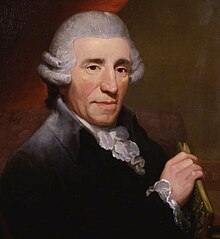
The first great master of the fashion was the composer Joseph Haydn. In the late 1750s he began composing symphonies, and by 1761 he had composed a triptych (Forenoon, Noon, and Evening) solidly in the contemporary mode. Equally a vice-Kapellmeister and afterward Kapellmeister, his output expanded: he equanimous over forty symphonies in the 1760s lonely. And while his fame grew, equally his orchestra was expanded and his compositions were copied and disseminated, his vocalism was only one amidst many.
While some scholars suggest that Haydn was overshadowed by Mozart and Beethoven, it would be difficult to overstate Haydn'south axis to the new style, and therefore to the time to come of Western fine art music as a whole. At the time, earlier the pre-eminence of Mozart or Beethoven, and with Johann Sebastian Bach known primarily to connoisseurs of keyboard music, Haydn reached a place in music that set him higher up all other composers except perhaps the Baroque era'southward George Frideric Handel. Haydn took existing ideas, and radically altered how they functioned—earning him the titles "father of the symphony" and "begetter of the string quartet".
Ane of the forces that worked as an impetus for his pressing forward was the first stirring of what would later on be called Romanticism—the Sturm und Drang, or "storm and stress" phase in the arts, a brusk catamenia where obvious and dramatic emotionalism was a stylistic preference. Haydn accordingly wanted more dramatic contrast and more than emotionally appealing melodies, with sharpened character and individuality in his pieces. This catamenia faded away in music and literature: notwithstanding, it influenced what came afterward and would eventually be a component of artful sense of taste in later decades.
The Farewell Symphony, No. 45 in F ♯ minor, exemplifies Haydn's integration of the differing demands of the new mode, with surprising sharp turns and a long slow adagio to end the piece of work. In 1772, Haydn completed his Opus 20 set of six cord quartets, in which he deployed the polyphonic techniques he had gathered from the previous Baroque era to provide structural coherence capable of property together his melodic ideas. For some, this marks the start of the "mature" Classical manner, in which the menstruation of reaction against late Bizarre complexity yielded to a catamenia of integration Baroque and Classical elements.
1775–1790 [edit]

Wolfgang Amadeus Mozart, posthumous painting by Barbara Krafft in 1819
Haydn, having worked for over a decade as the music director for a prince, had far more resource and scope for composing than most other composers. His position also gave him the ability to shape the forces that would play his music, as he could select skilled musicians. This opportunity was not wasted, as Haydn, get-go quite early on on his career, sought to press frontward the technique of building and developing ideas in his music. His next important quantum was in the Opus 33 string quartets (1781), in which the melodic and the harmonic roles segue amid the instruments: it is often momentarily unclear what is melody and what is harmony. This changes the manner the ensemble works its mode between dramatic moments of transition and climactic sections: the music flows smoothly and without obvious pause. He then took this integrated manner and began applying it to orchestral and vocal music.

Haydn's souvenir to music was a style of composing, a way of structuring works, which was at the same time in accord with the governing aesthetic of the new style. However, a younger contemporary, Wolfgang Amadeus Mozart, brought his genius to Haydn'southward ideas and applied them to two of the major genres of the day: opera, and the virtuoso concerto. Whereas Haydn spent much of his working life as a courtroom composer, Mozart wanted public success in the concert life of cities, playing for the general public. This meant he needed to write operas and write and perform virtuoso pieces. Haydn was non a virtuoso at the international touring level; nor was he seeking to create operatic works that could play for many nights in forepart of a large audience. Mozart wanted to reach both. Moreover, Mozart also had a taste for more chromatic chords (and greater contrasts in harmonic language mostly), a greater love for creating a welter of melodies in a single piece of work, and a more than Italianate sensibility in music as a whole. He institute, in Haydn'south music and later in his study of the polyphony of J.S. Bach, the means to subject and enrich his artistic gifts.

The Mozart family c. 1780. The portrait on the wall is of Mozart's mother.
Mozart rapidly came to the attention of Haydn, who hailed the new composer, studied his works, and considered the younger homo his merely true peer in music. In Mozart, Haydn found a greater range of instrumentation, dramatic event and melodic resource. The learning human relationship moved in both directions. Mozart also had a bang-up respect for the older, more experienced composer, and sought to learn from him.
Mozart's arrival in Vienna in 1780 brought an dispatch in the development of the Classical manner. There, Mozart captivated the fusion of Italianate brilliance and Germanic cohesiveness that had been brewing for the previous twenty years. His own taste for flashy brilliances, rhythmically complex melodies and figures, long cantilena melodies, and virtuoso flourishes was merged with an appreciation for formal coherence and internal connection. It is at this point that war and economic aggrandizement halted a trend to larger orchestras and forced the disbanding or reduction of many theater orchestras. This pressed the Classical way in: toward seeking greater ensemble and technical challenges—for case, scattering the tune beyond woodwinds, or using a melody harmonized in thirds. This process placed a premium on small ensemble music, called chamber music. Information technology likewise led to a tendency for more public functioning, giving a further boost to the string quartet and other small ensemble groupings.
It was during this decade that public sense of taste began, increasingly, to recognize that Haydn and Mozart had reached a high standard of composition. By the time Mozart arrived at age 25, in 1781, the ascendant styles of Vienna were recognizably continued to the emergence in the 1750s of the early Classical style. Past the finish of the 1780s, changes in performance practise, the relative standing of instrumental and song music, technical demands on musicians, and stylistic unity had become established in the composers who imitated Mozart and Haydn. During this decade Mozart composed his most famous operas, his six late symphonies that helped to redefine the genre, and a cord of piano concerti that still stand at the height of these forms.
One composer who was influential in spreading the more serious style that Mozart and Haydn had formed is Muzio Clementi, a gifted virtuoso pianist who tied with Mozart in a musical "duel" before the emperor in which they each improvised on the pianoforte and performed their compositions. Clementi'southward sonatas for the piano circulated widely, and he became the almost successful composer in London during the 1780s. Too in London at this time was Jan Ladislav Dussek, who, like Clementi, encouraged pianoforte makers to extend the range and other features of their instruments, and so fully exploited the newly opened up possibilities. The importance of London in the Classical menstruum is oft disregarded, just it served equally the home to the Broadwood's factory for piano manufacturing and equally the base for composers who, while less notable than the "Vienna School", had a decisive influence on what came subsequently. They were composers of many fine works, notable in their own right. London's gustation for virtuosity may well have encouraged the complex passage work and extended statements on tonic and ascendant.
Effectually 1790–1820 [edit]
When Haydn and Mozart began composing, symphonies were played as single movements—earlier, between, or as interludes inside other works—and many of them lasted only ten or twelve minutes; instrumental groups had varying standards of playing, and the continuo was a central part of music-making.
In the intervening years, the social globe of music had seen dramatic changes. International publication and touring had grown explosively, and concert societies formed. Notation became more specific, more descriptive—and schematics for works had been simplified (yet became more than varied in their exact working out). In 1790, but before Mozart's death, with his reputation spreading rapidly, Haydn was poised for a serial of successes, notably his late oratorios and London symphonies. Composers in Paris, Rome, and all over Germany turned to Haydn and Mozart for their ideas on course.
In the 1790s, a new generation of composers, born around 1770, emerged. While they had grown up with the before styles, they heard in the recent works of Haydn and Mozart a vehicle for greater expression. In 1788 Luigi Cherubini settled in Paris and in 1791 equanimous Lodoiska, an opera that raised him to fame. Its style is clearly reflective of the mature Haydn and Mozart, and its instrumentation gave it a weight that had not nevertheless been felt in the m opera. His contemporary Étienne Méhul extended instrumental furnishings with his 1790 opera Euphrosine et Coradin, from which followed a series of successes. The final push towards modify came from Gaspare Spontini, who was deeply admired past hereafter romantic composers such as Weber, Berlioz and Wagner. The innovative harmonic language of his operas, their refined instrumentation and their "enchained" closed numbers (a structural pattern which was later adopted by Weber in Euryanthe and from him handed down, through Marschner, to Wagner), formed the basis from which French and German romantic opera had its ancestry.
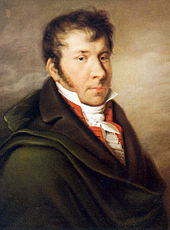
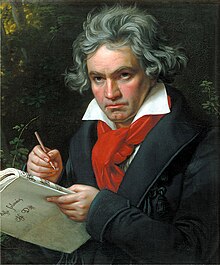
The about fateful of the new generation was Ludwig van Beethoven, who launched his numbered works in 1794 with a fix of iii piano trios, which remain in the repertoire. Somewhat younger than the others, though equally accomplished considering of his youthful study under Mozart and his native virtuosity, was Johann Nepomuk Hummel. Hummel studied under Haydn too; he was a friend to Beethoven and Franz Schubert. He full-bodied more on the pianoforte than any other musical instrument, and his time in London in 1791 and 1792 generated the composition and publication in 1793 of three piano sonatas, opus 2, which idiomatically used Mozart'southward techniques of avoiding the expected cadence, and Clementi's sometimes modally uncertain virtuoso figuration. Taken together, these composers tin can be seen as the vanguard of a broad alter in style and the center of music. They studied one some other's works, copied one another'south gestures in music, and on occasion behaved like quarrelsome rivals.
The crucial differences with the previous wave tin be seen in the downward shift in melodies, increasing durations of movements, the acceptance of Mozart and Haydn as paradigmatic, the greater use of keyboard resource, the shift from "song" writing to "pianistic" writing, the growing pull of the minor and of modal ambiguity, and the increasing importance of varying accompanying figures to bring "texture" forward equally an element in music. In short, the belatedly Classical was seeking music that was internally more complex. The growth of concert societies and apprentice orchestras, marking the importance of music as role of middle-form life, contributed to a booming marketplace for pianos, piano music, and virtuosi to serve as exemplars. Hummel, Beethoven, and Clementi were all renowned for their improvising.
The direct influence of the Bizarre continued to fade: the figured bass grew less prominent as a means of holding performance together, the performance practices of the mid-18th century continued to dice out. All the same, at the same fourth dimension, complete editions of Bizarre masters began to get available, and the influence of Baroque style continued to grow, particularly in the e'er more than expansive use of brass. Another feature of the menstruum is the growing number of performances where the composer was not present. This led to increased item and specificity in annotation; for case, there were fewer "optional" parts that stood separately from the master score.
The force of these shifts became apparent with Beethoven'southward 3rd Symphony, given the name Eroica, which is Italian for "heroic", by the composer. As with Stravinsky'south The Rite of Leap, it may not have been the first in all of its innovations, just its aggressive use of every part of the Classical style set it apart from its contemporary works: in length, appetite, and harmonic resource as well.
First Viennese School [edit]

The Beginning Viennese School is a name mostly used to refer to iii composers of the Classical menstruum in late-18th-century Vienna: Haydn, Mozart, and Beethoven. Franz Schubert is occasionally added to the list.
In German-speaking countries, the term Wiener Klassik (lit. Viennese classical era/fine art) is used. That term is often more broadly practical to the Classical era in music equally a whole, as a means to distinguish it from other periods that are colloquially referred to as classical, namely Baroque and Romantic music.
The term "Viennese School" was first used by Austrian musicologist Raphael Georg Kiesewetter in 1834, although he only counted Haydn and Mozart as members of the school. Other writers followed adapt, and eventually Beethoven was added to the list.[6] The designation "first" is added today to avoid confusion with the 2nd Viennese Schoolhouse.
Whilst, Schubert apart, these composers certainly knew each other (with Haydn and Mozart even being occasional chamber-music partners), there is no sense in which they were engaged in a collaborative effort in the sense that one would associate with 20th-century schools such equally the Second Viennese School, or Les 6. Nor is there any meaning sense in which ane composer was "schooled" by some other (in the fashion that Berg and Webern were taught by Schoenberg), though it is true that Beethoven for a fourth dimension received lessons from Haydn.
Attempts to extend the Showtime Viennese School to include such later figures equally Anton Bruckner, Johannes Brahms, and Gustav Mahler are only journalistic, and never encountered in academic musicology.
Classical influence on later composers [edit]

Musical eras and their prevalent styles, forms and instruments seldom disappear at once; instead, features are replaced over time, until the old arroyo is merely felt every bit "old-fashioned". The Classical fashion did not "dice" suddenly; rather, information technology gradually got phased out under the weight of changes. To requite just one example, while it is generally stated that the Classical era stopped using the harpsichord in orchestras, this did not happen all of a sudden at the start of the Classical era in 1750. Rather, orchestras slowly stopped using the harpsichord to play basso continuo until the practice was discontinued past the stop of the 1700s.

One crucial modify was the shift towards harmonies centering on "flatward" keys: shifts in the subdominant direction[ clarification needed ]. In the Classical style, major key was far more common than minor, chromaticism existence chastened through the use of "sharpward" modulation (e.g., a piece in C major modulating to G major, D major, or A major, all of which are keys with more sharps). Likewise, sections in the small-scale fashion were often used for dissimilarity. Beginning with Mozart and Clementi, in that location began a creeping colonization of the subdominant region (the 2 or IV chord, which in the fundamental of C major would be the keys of d modest or F major). With Schubert, subdominant modulations flourished afterward being introduced in contexts in which before composers would have bars themselves to dominant shifts (modulations to the dominant chord, eastward.g., in the key of C major, modulating to G major). This introduced darker colors to music, strengthened the small-scale mode, and fabricated structure harder to maintain. Beethoven contributed to this by his increasing use of the fourth equally a consonance, and modal ambiguity—for example, the opening of the Symphony No. nine in D small.
Ludwig van Beethoven, Franz Schubert, Carl Maria von Weber, and John Field are among the most prominent in this generation of "Proto-Romantics", along with the young Felix Mendelssohn. Their sense of grade was strongly influenced by the Classical style. While they were not yet "learned" composers (imitating rules which were codified past others), they directly responded to works past Haydn, Mozart, Clementi, and others, as they encountered them. The instrumental forces at their disposal in orchestras were also quite "Classical" in number and variety, permitting similarity with Classical works.
However, the forces destined to stop the concur of the Classical way gathered force in the works of many of the in a higher place composers, particularly Beethoven. The most commonly cited ane is harmonic innovation. Also important is the increasing focus on having a continuous and rhythmically uniform accompanying figuration: Beethoven'southward Moonlight Sonata was the model for hundreds of afterward pieces—where the shifting movement of a rhythmic figure provides much of the drama and involvement of the work, while a melody drifts above it. Greater cognition of works, greater instrumental expertise, increasing variety of instruments, the growth of concert societies, and the unstoppable domination of the increasingly more than powerful piano (which was given a bolder, louder tone past technological developments such every bit the utilise of steel strings, heavy cast-fe frames and sympathetically vibrating strings) all created a huge audience for sophisticated music. All of these trends contributed to the shift to the "Romantic" way.
Drawing the line between these ii styles is very difficult: some sections of Mozart's later on works, taken alone, are indistinguishable in harmony and orchestration from music written 80 years later—and some composers continued to write in normative Classical styles into the early on 20th century. Even before Beethoven's death, composers such as Louis Spohr were cocky-described Romantics, incorporating, for example, more improvident chromaticism in their works (e.thou., using chromatic harmonies in a piece's chord progression). Conversely, works such as Schubert's Symphony No. 5, written during the chronological end of the Clasaical era and dawn of the Romantic era, exhibit a deliberately anachronistic creative paradigm, harking dorsum to the compositional manner of several decades before.
However, Vienna'south fall as the nearly important musical center for orchestral composition during the late 1820s, precipitated by the deaths of Beethoven and Schubert, marked the Classical style's final eclipse—and the cease of its continuous organic development of i composer learning in close proximity to others. Franz Liszt and Frédéric Chopin visited Vienna when they were young, simply they then moved on to other cities. Composers such every bit Carl Czerny, while securely influenced by Beethoven, also searched for new ideas and new forms to incorporate the larger world of musical expression and performance in which they lived.
Renewed interest in the formal residue and restraint of 18th century classical music led in the early 20th century to the development of and then-chosen Neoclassical style, which numbered Stravinsky and Prokofiev among its proponents, at least at certain times in their careers.
Classical period instruments [edit]
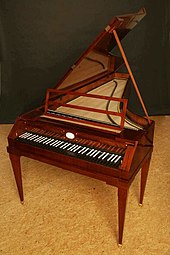
Fortepiano by Paul McNulty later on Walter & Sohn, c. 1805
Guitar [edit]
The Bizarre guitar, with 4 or five sets of double strings or "courses" and elaborately decorated soundhole, was a very unlike instrument from the early classical guitar which more than closely resembles the modern instrument with the standard six strings. Judging past the number of instructional manuals published for the instrument – over three hundred texts were published by over two hundred authors between 1760 and 1860 – the classical period marked a golden age for guitar.[7]
Strings [edit]
In the Bizarre era, there was more diverseness in the bowed stringed instruments used in ensembles, with instruments such as the viola d'amore and a range of fretted viols existence used, ranging from modest viols to large bass viols. In the Classical period, the string department of the orchestra was standardized as merely four instruments:
- Violin (in orchestras and bedroom music, typically in that location are first violins and second violins, with the old playing the melody and/or a higher line and the latter playing either a countermelody, a harmony part, a part below the first violin line in pitch, or an accessory line)
- Viola (the alto voice of the orchestral string department and string quartet; information technology oft performs "inner voices", which are accompaniment lines which fill in the harmony of the piece)
- Cello (the cello plays ii roles in Classical era music; at times it is used to play the bassline of the slice, typically doubled past the double basses [Note: When cellos and double basses read the same bassline, the basses play an octave below the cellos, because the bass is a transposing musical instrument]; and at other times it performs melodies and solos in the lower register)
- Double bass (the bass typically performs the lowest pitches in the string section in society to provide the bassline for the slice)
In the Baroque era, the double bass players were non commonly given a separate part; instead, they typically played the same basso continuo bassline that the cellos and other low-pitched instruments (due east.g., theorbo, snake wind instrument, viols), admitting an octave below the cellos, considering the double bass is a transposing instrument that sounds i octave lower than it is written. In the Classical era, some composers continued to write only i bass part for their symphony, labeled "bassi"; this bass part was played by cellists and double bassists. During the Classical era, some composers began to give the double basses their own role.
Woodwinds [edit]
- Basset clarinet
- Basset horn
- Clarinette d'amour
- Classical clarinet
- Chalumeau
- Flute
- Oboe
- Bassoon
Percussion [edit]
- Timpani
- "Turkish music":
- Bass drum
- Cymbals
- Triangle
Keyboards [edit]
- Clavichord
- Fortepiano (the forerunner to the modern piano)
- Piano
- Harpsichord, the standard Baroque era basso continuo keyboard musical instrument, was used until the 1750s, later which time it was gradually phased out, and replaced with the fortepiano and then the piano. Past the early on 1800s, the harpsichord was no longer used.
Brasses [edit]
- Buccin
- Ophicleide – replacement for the "serpent", a bass wind musical instrument that was the forerunner of the tuba
- French horn
- Trumpet
- Trombone
Meet as well [edit]
- List of Classical-era composers
Notes [edit]
- ^ Burton, Anthony (2002). A Performer'south Guide to the Music of the Classical Menstruation. London: Associated Board of the Royal Schools of Music. p. three. ISBN978-one-86096-1939.
- ^ a b Blume, Friedrich. Classic and Romantic Music: A Comprehensive Survey. New York: W. Westward. Norton, 1970
- ^ a b c Kamien, Roger. Music: An Appreciation. 6th. New York: McGraw Hill, 2008. Print.
- ^ a b Rosen, Charles. The Classical Style, pp. 43–44. New York: Due west. W. Norton & Visitor, 1998
- ^ Rosen, Charles. The Classical Style, pp. 44. New York: W. Due west. Norton & Company, 1998
- ^ Heartz, Daniel & Brown, Bruce Alan (2001). "Classical". In Sadie, Stanley & Tyrrell, John (eds.). The New Grove Lexicon of Music and Musicians (2nd ed.). London: Macmillan.
- ^ Stenstadvold, Erik. An Annotated Bibliography of Guitar Methods, 1760–1860 (Hillsdale, New York: Pendragon Press, 2010), xi.
Farther reading [edit]
- Downs, Philip Yard. (1992). Classical Music: The Era of Haydn, Mozart, and Beethoven, fourth vol of Norton Introduction to Music History. Due west. West. Norton. ISBN 0-393-95191-10 (hardcover).
- Grout, Donald Jay; Palisca, Claude V. (1996). A History of Western Music, Fifth Edition. W. Westward. Norton. ISBN 0-393-96904-5 (hardcover).
- Hanning, Barbara Russano; Grout, Donald Jay (1998 rev. 2006). Concise History of Western Music. West. W. Norton. ISBN 0-393-92803-9 (hardcover).
- Kennedy, Michael (2006), The Oxford Dictionary of Music, 985 pages, ISBN 0-19-861459-4
- Lihoreau, Tim; Fry, Stephen (2004). Stephen Fry's Incomplete and Utter History of Classical Music. Boxtree. ISBN 978-0-7522-2534-0
- Rosen, Charles (1972 expanded 1997). The Classical Mode. New York: W. W. Norton. ISBN 978-0-393-04020-3 (expanded edition with CD, 1997)
- Taruskin, Richard (2005, rev. Paperback version 2009). Oxford History of Western Music. Oxford University Press (US). ISBN 978-0-19-516979-ix (Hardback), ISBN 978-0-19-538630-i (Paperback)
External links [edit]
- Classical Net – Classical music reference site
- Gratis scores by various classical composers at the International Music Score Library Projection (IMSLP)
Source: https://en.wikipedia.org/wiki/Classical_period_%28music%29
0 Response to "in what era did composers begin to be recognized"
Postar um comentário