Murphy Jessica Heilbrunn Timeline of Art History the Mets Heilbrunn Timeline of Art
History has provided a mass of adroit art influenced by differing philosophies, traditions, cultures, principles and ideologies.
These artworks produced over the years can be seen and felt as arresting, acclaimed, awe-inspiring and aesthetically pleasing with a number of them being accomplished, distinctive and elevating in abstract grade.
In spite of the fact that classifications tin can be seen as remissive, unlike artistic styles, visuals and tendencies can exist grouped into collectives called art movements.
The nomenclature of art with its various respective movements can be an academic discipline in its own right.
Though initially it may seem overly complex or polarizing, acquainting yourself with the top art styles and movements throughout history will equip you with a ameliorate understanding and appreciation of art every bit a whole while removing whatsoever apprehensions in art such equally the notion that art tin can only be understood by those that accept dedicated their lives to studying information technology or by the supposedly rare and gifted bunch.
In essence, Art is just one mode to communicate without a linguistic communication barrier.
Essential Art Movements and Styles
The following is an alphabetically arranged list of the superlative fine art styles and movements throughout history and a brief discussion of each:
- Abstruse Expressionism
- Art Deco
- Fine art Nouveau
- Advanced
- Baroque
- Bauhaus
- Classicism
- Conceptual Art
- Constructivism
- Cubism
- Dada / Dadaism
- Expressionism
- Fauvism
- Futurism
- Impressionism
- Installation Art
- Land Art
- Minimalism
- Neo Impressionism
- Neoclassicism
- Performance Fine art
- Pop Art
- Postal service Impressionism
- Precisionism
- Rococo
- Surrealism
- Suprematism
- Symbolism
Abstract Expressionism
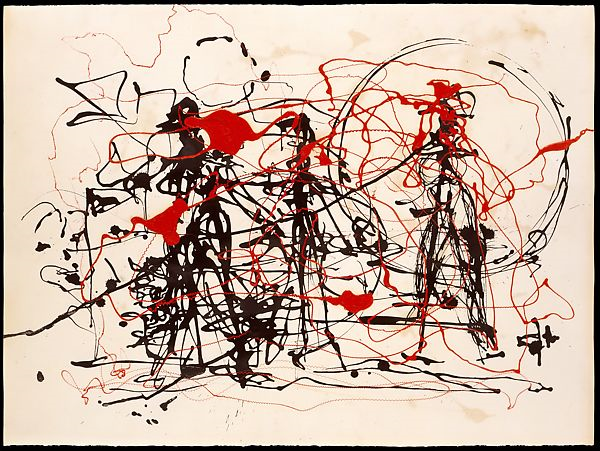
"Untitled" by Jackson Pollock ca. 1948 – 1949
IMAGE SOURCE: The Heilbrunn Timeline of Art History (Pollock, north.d.)
In the 1940s a movement as well known as The New York Schoolhouse was established to showcase abstract art intended to reverberate the individual psyches (Paul, 2004) through 'activity painted' unplanned brush strokes that would sweep across or baste pigment in unpremeditated patterns on large canvases.
Though the Abstract Expressionism move incorporated other types of media in add-on to large painted canvases such as sculptures and nontraditional painting materials paired with new techniques of painting on canvas that was intentionally non stretched, not primed or even both.
Abstruse Expressionism formed a distinctly American style of art. (MoMA Learning, n.d.)
Art Deco
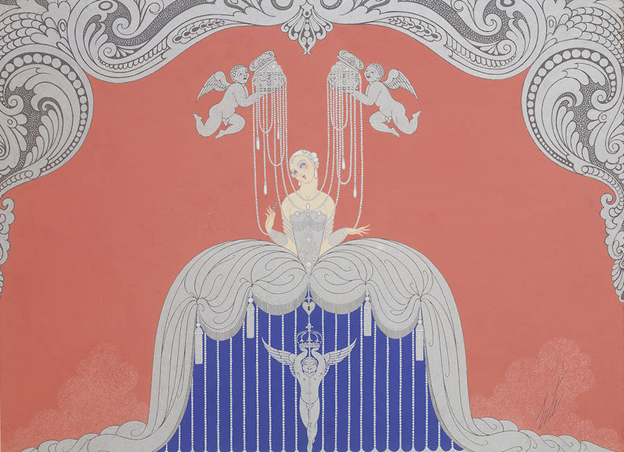
"Costume pour Le Triomphe de la femme" past Roman Petrovich Tyrtov (pseudonym ' Erté') 1926
Epitome SOURCE: The Land Hermitage Museum (Tyrtov)
Art Deco – referred to at times equally Deco and is seen as a response contra to Art Nouveau that it succeeded (Tate, due north.d.) – is a pattern fashion emerging in the 1920s and 1930s characterized past geometrically symmetrical shapes that were streamlined and oft straightforward.
Art Deco intended to be pleasing to the center without much intellectual idea or debate backside it (The Art Story, due north.d.).
Although the Deco fine art way was illustrated in diverse artworks from drawings, sketches, to different paintings in mediums similar gouache, it is also considered an architectural fashion and is seen throughout various visuals such every bit construction, furniture, sculpture and decorative arts that can also be seen in interior pattern.
(Pennsylvania Historical and Museum Commission, n.d.)
Art Nouveau
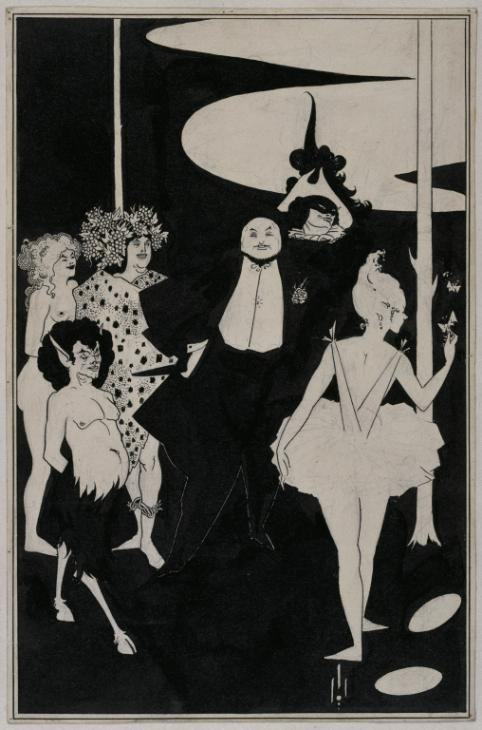
Design for the Frontispiece to John Davidson's Plays by Aubrey Beardsley 1894
IMAGE SOURCE: The Tate Exhibit (Beardsley)
Booming in the 1890s, Art Nouveau went past the names of Glasgow Way, Jugendstil (Germany), Stile Floreale (Italia), Sezessionstil (Austria) and was influenced by the lines and geometric shapes of stems and establish blossoms creating decorative and graphic fine art that would display elegant united forms that flowed naturally.
Linearly laid out contours took priority over colors which were exhibited in muted earthy tones of black, greyness, brownish, yellow and blue. (The Art Story, n.d.)
Like Fine art Deco, the Art Nouveau mode was represented in various visual arts inclusive of compages, piece of furniture, sculpture and decorative pieces, oft having the interior of Art Nouveau buildings as intricate as its exterior (Stamp, 2016)
Avant-garde
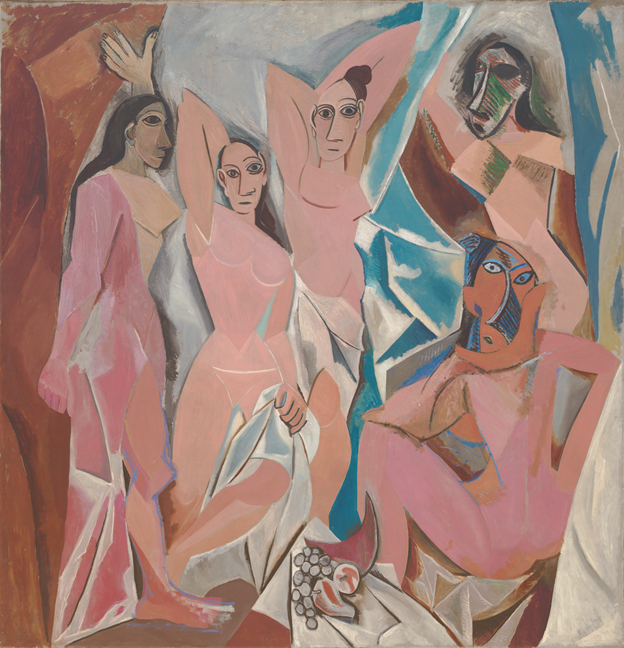
Les Demoiselles d'Avignon by Pablo Picasso June to July 1907
IMAGE SOURCE: The Museum of Modern Art MoMA (Picasso, Les Demoiselles d'Avignon)
Considered as emerging in the 1850s, Avant-garde is a French term for the trunk of soldiers positioned to become alee of the rest of the army in preparation for the master body of the army, besides known equally vanguard or advanced guard in English.
Avant-garde'due south chief idea is to have art evaluated principally on the artist'due south concepts and perceptions (Tate, n.d.)
In some avant-garde movements, the art produced was an image of a yearning to break free from social norms and mainstream aesthetic conventions with associations to radical social or political change and calendar (The Art Story, northward.d.)
Baroque
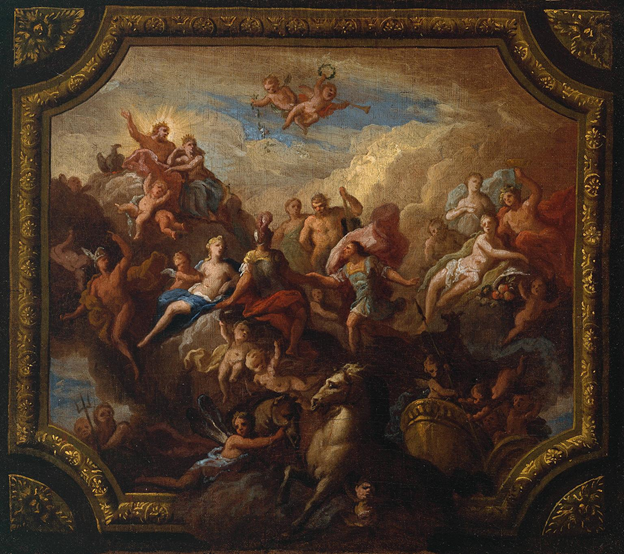
The Apotheosis of Romulus: Sketch for a Ceiling Decoration, Maybe for Hewell Grange, Worcestershire by Sir James Thornhill c.1710
Paradigm SOURCE: The Tate Showroom (Thornhill)
Bizarre is an art move that peaked in Rome at about 1630 – 1680 and is a term that stands for 'irregularly shaped pearl' originating from the Portuguese word 'barocco'. Baroque is an art style that is relevant to the Catholic Counter Reformation though it can be seen in non-religious subjects portraying mythical creatures, still life or portraits.
Baroque is marked by a realism that makes the viewer feel as if they were there to witness the actual events of the paintings unfold. (Tate, n.d.)
A central component of Baroque is the use of light and dark colors to generate dramatic tension tied to a straight emotional appeal.
Baroque architecture is pronounced by opulence and an inclination for the highly ornamented. (The Art Story, n.d.)
Bauhaus
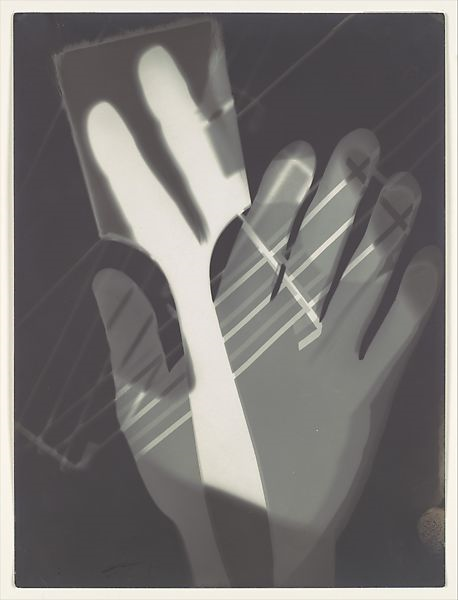
Fotogramm by László Moholy-Nagy 1926
IMAGE SOURCE: The Met Museum (Moholy-Nagy)
Established in 1919 by Walter Gropius in Frg, the Bauhaus teaching methodology took an innovative arroyo into arts where traditional student-instructor learnings were discarded for artistic community learning that concentrated on the creation of functionality and dazzler.
Bauhaus targeted to requite interior blueprint, architecture, performing arts and applied arts as much importance as fine arts. (Tate, northward.d.) Bauhaus became a new method of living, giving fashion to Gropius' vision of a "utopian arts and crafts society combining architecture, sculpture, and painting into a single creative expression." (Winton, 2007)
Classicism
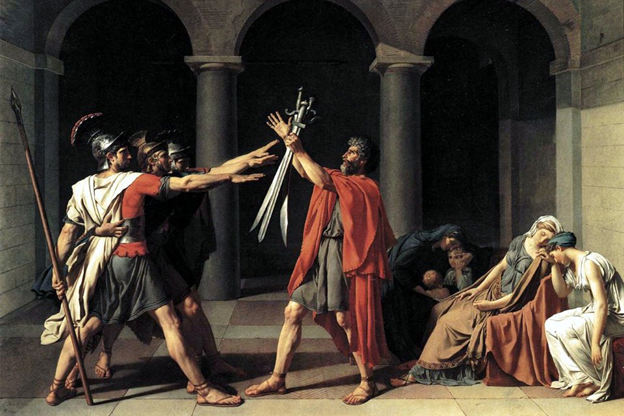
Oath of the Horatii by Jacques-Louis David 1784
Prototype SOURCE: HiSoUR (David)
Classicism is reminiscent of ancient art of Greek and Rome, showtime emerging during the Italian Renaissance after the fall of Byzantium.
(Fine art History, n.d.) Works of Classicism embodied ideals that inspire and served as the standards for nobility, soundness of logic, power, and verity of which beauty is the upshot thereof. (HiSoUR, n.d.) This fine art style focuses on accordance, moderation, refinement and deference (Tate, n.d.) to the compelling models of imitation that Classicism would describe regarding the ideal man experience.
Conceptual Art
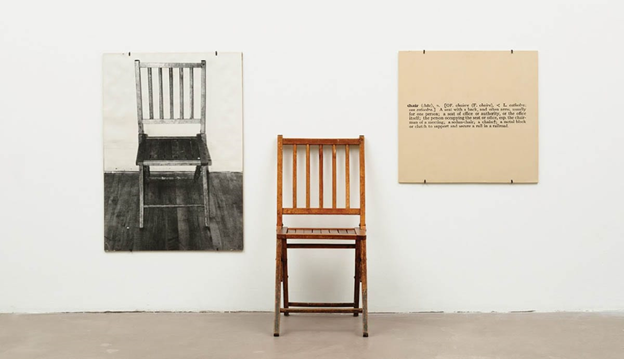
One and Iii Chairs by Joseph Kosuth 1965
Paradigm SOURCE: The Museum of Modernistic Fine art MoMA (Kosuth)
Conceptualism, more commonly known equally Conceptual Fine art, arose as a movement in the 1960s and is used to refer to art made in the mid-1960s until the mid-1970s.
This movement places more than importance on the vision, concept or idea behind the fine art rather than the actual physical production.
(Tate, n.d.) Artist Sol Lewitt coined the term to describe this new fine art nomenclature in his 1967 essay entitled Paragraphs on Conceptual Art where he wrote "The idea itself, even if it is not made visual, is equally much of a piece of work of art as whatsoever finished product." (MoMA Learning, due north.d.)
Constructivism
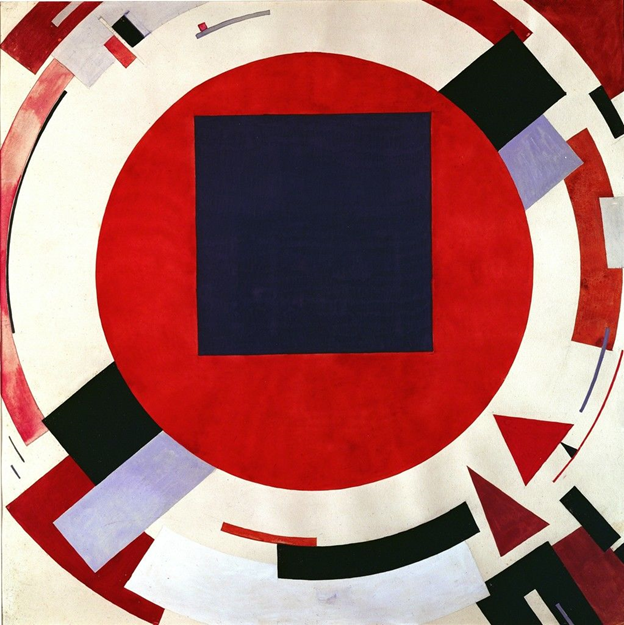
Proun (Project for Progress) by El Lissitzky 1924
IMAGE SOURCE: Stedelijk Van Abbemuseum, Eindhoven (Lissitzky)
Constructivism as a branch of abstract fine art was industrialized by the Russian avant-garde in 1915 – 1940 aimed at the ideal that art should be directed towards beingness used as a tool for sociopolitical purposes such as the Communist Revolution.
Constructivists did not believe in the idea of "art for fine art'south sake" with Aleksei Gan, an avant-garde artist who was a fundamental figure in developing Constructivism, declaring that "We [constructivists] declare uncompromising state of war on fine art!" (Artland, n.d.) Constructivism is primarily geometric with a penchant for accuracy in composition washed through the help of mathematics and measuring tools if needed.
Cubism
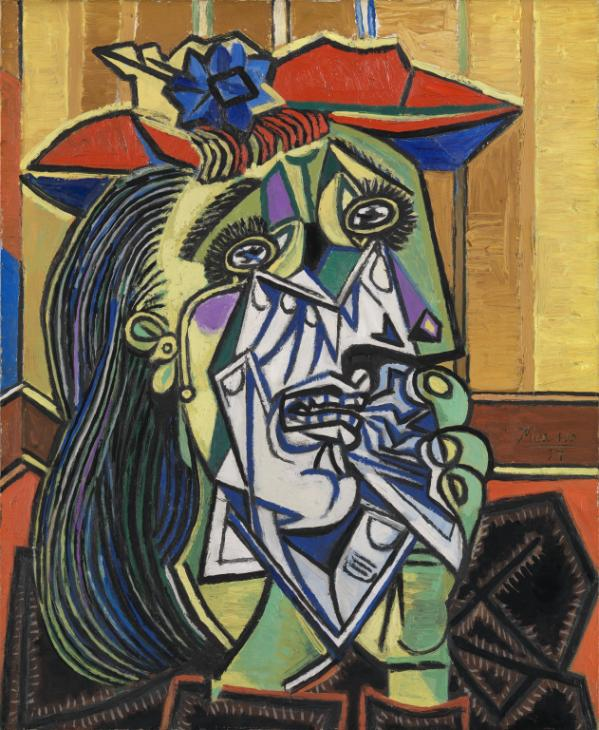
Weeping Woman (original title "Femme en pleurs") past Pablo Picasso 1937
IMAGE SOURCE: The Tate Showroom (Picasso, Weeping Adult female)
Invented by the artists Pablo Picasso and Georges Braque in approximately 1907 – 1908, Cubism presented the differing perspectives of traditional subjects such every bit objects or figures in one canvas leading to an abstruse, fragmented fine art style whose visual linguistic communication consists of translating objects and figures into apparent geometrical planes.
(Tate, n.d.) As described by the refugee artist named Jacques Lipchitz, "Cubism is similar continuing at a certain betoken on a mount and looking around.
If you go higher, things volition look different; if yous become lower, once more, they will look different. It is a signal of view." (Lipchitz)
Dada / Dadaism
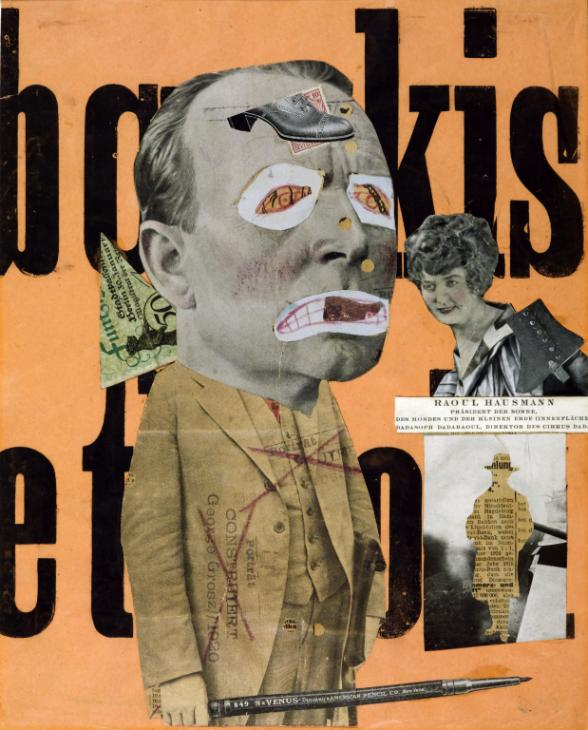
The Art Critic by Raoul Hausmann 1919 – 1920
IMAGE SOURCE: The Tate Showroom (Hausmann)
Emerging during the First World War (1914 – 1918) in Zurich as an opposing creative response to the habitually suppressive and disciplinarian societal norms and practices, Dada or Dadaism sought to question the exploitive fundamentals of state of war and established conventions of logic or gild that make up the degrading social structures.
(Tate, n.d.) Dada artists embodied a protest move with the aesthetics of the art produced only secondary to the beliefs beingness visually communicated.
Hugo Ball, a poet and writer who founded Dada, wrote that "For united states, art is not an cease in itself, but it is an opportunity for the truthful perception and criticism of the times we live in." (MoMA Learning, north.d.)
Expressionism
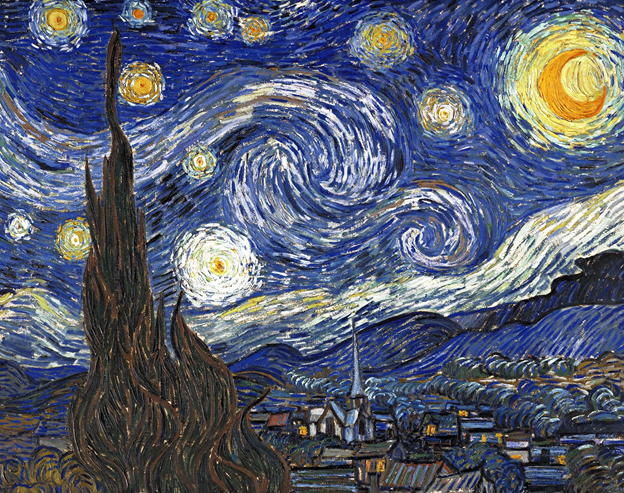
The Starry Night by Vincent van Gogh 1889
Paradigm SOURCE: History Annal (Gogh, The Starry Nighttime)
Emerging prominently in Germany and Austria between 1905 and 1920, Expressionism was a way for artists to relay their feelings, ideas and emotional experiences first and foremost without much regard to physical reality past portraying the world as information technology felt and not as it looks during a time full of apprehension, fears, distress and worries amongst the devastation acquired by Globe State of war I (MoMA Learning, northward.d.) Expressionism favors exaggerated execution of color through distorted, swaying or swirling brush strokes intended to invoke an emotional response to the anxieties of the modern world. (The Fine art Story, due north.d.)
Fauvism
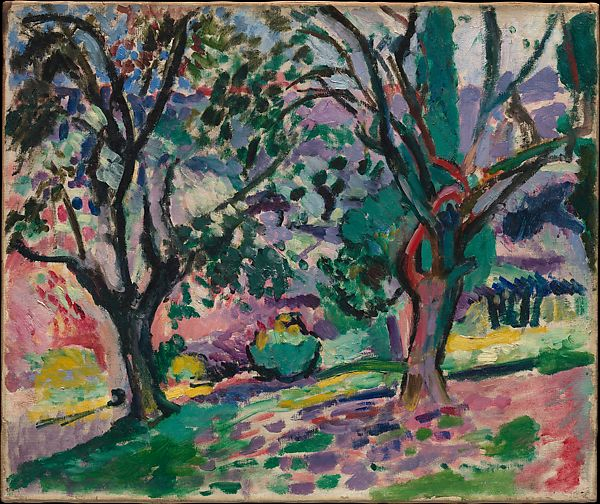
Olive Trees at Collioure by Henri Matisse 1906
Paradigm SOURCE: The Met Museum (Matisse)
The critic Louis Vauxcelles coined the term Fauvism from the French words les fauves pregnant 'the wild beasts' in response to seeing the art of Henri Matisse and Andre Derain composed of bold, vibrant colors that were not natural to the subjects so simplified it began appearing abstract every bit they were painted with unpremeditated dabs of loose paint oft practical straight out of the tube. (Tate, north.d.)
Fauvism had a radical goal of making color independent from its traditionally descriptive and representative purpose to make way for information technology to exist on the canvas as a sovereign element. These bright colors would be used to define calorie-free and space. (The Art Story, n.d.)
Futurism
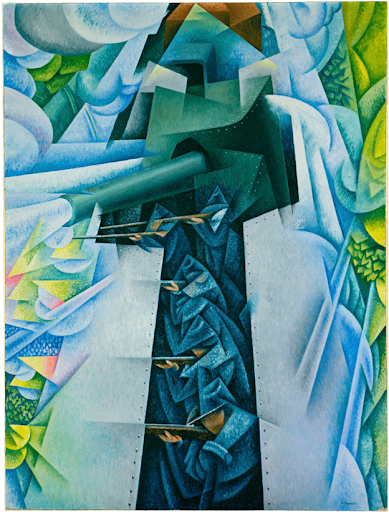
Armored Train in Activeness by Gino Severini 1915
Epitome SOURCE: The New Yorker. Art Courtesy by The Museum of Modern art also known equally MoMA (Severini)
Initiated in 1909 past the Italian poet Filippo Tommaso Marinette, Futurism aimed to capture the dynamics of the mod mechanical world and its velocity through abstract art and literature.
Futurism heavily condemns the civilisation of a repressive, tyrannical by. Instead, Futurists promoted the celebration of the modern industrial and technological world through fine art. (Tate, n.d.)
Futurism artworks depicted a primal focus to movement, motion or being dynamic with a number of novel methods beingness established such as repetition, blurring and the use of lines of force. (The Fine art Story, northward.d.)
Impressionism
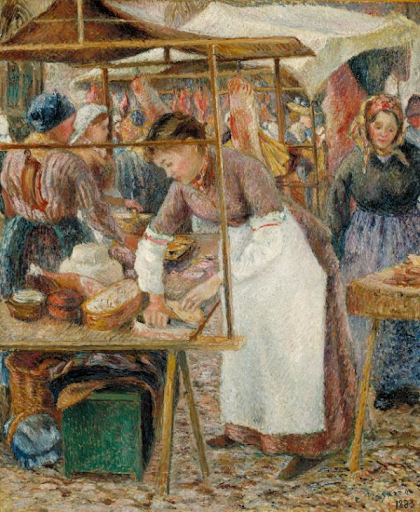
The Pork Butcher past Camille Pissaro 1883
IMAGE SOURCE: The Tate Exhibit (Pissaro)
Founded in 1874 by Claude Monet, Edgar Degas, Camille Pissarro, and Alfred Sisley amid others (Samu, 2004), Impressionism is a motility that consisted of vivid colors painted on with brushstrokes that tended to exist lighter, looser and less rigidly structured than other fine art styles (The Art Story, n.d.) Impressionism was more about capturing the 'impressions' of everyday life and move as it happened in the eyes of the creative person that produced the art.
Impressionism meant to reflect what was seen at the moment. (Tate, n.d.) Information technology is at its cadre anti-academic and independent from annual exhibitions sponsored by the government known as Salons, choosing instead to exhibit art in venues other than established exhibitions.
Installation Art
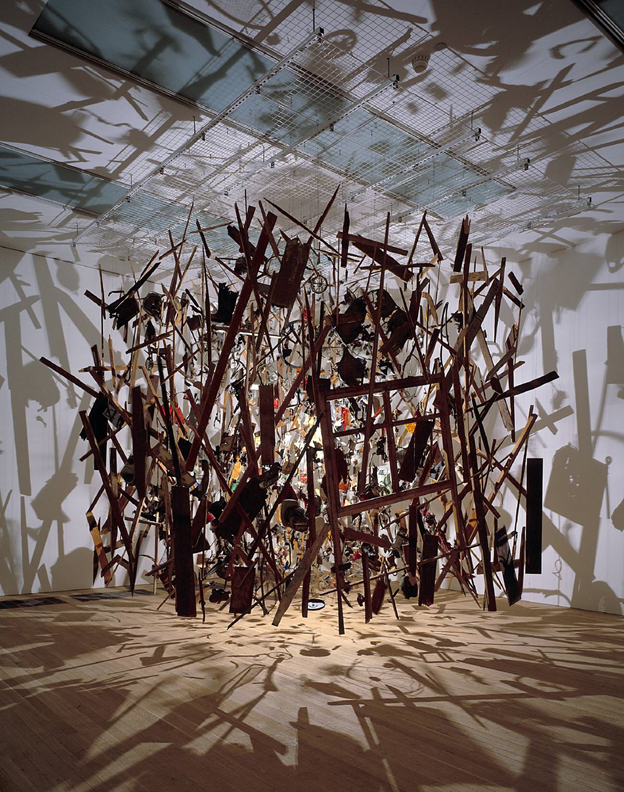
Cold Dark Matter: An Exploded View by Cornelia Parker 1991
IMAGE SOURCE: The Tate Showroom (Parker)
Emerging in the belatedly 1950s, Installation Art also known every bit 'environments' is a movement that made use of mixed media materials and constructions that were scaled to fit specifically on site to create artworks that needed to be walked through or effectually in order to be completely contemplated or in gild to exist fully engaged with the art.
Installation art was created to exist an experience that was absolutely integrated instead of being a display of individually separated art pieces. (Tate, n.d.)
The Installation Art movement pushes against commodifying art by making artworks that are difficult to sell or collect and in so doing, the artworks made cannot be measured by the traditional mechanisms or criteria for determining its budgetary value. (The Art Story, n.d.)
Land Art
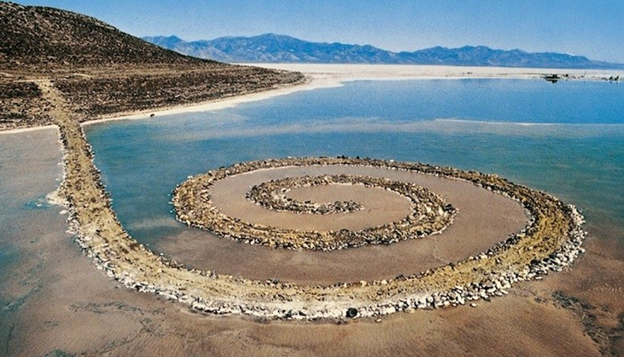
Spiral Jetty by Robert Smithson 1970
Prototype SOURCE: Art Space (Smithson)
Arising in the 1960s and 1970s Land Art also known every bit Globe Art, Earthworks or Environmental Art (The Fine art Story, n.d.), is the limerick of natural elements or materials such every bit soil, water, gravel, rocks, twigs, plants and trees into sculptures, structures or other landscaped based forms (Tate, n.d.) usually on a monumental calibration though Land Art has besides been made in galleries or past bringing landscape materials to make installations.
In a mode, Land Fine art can exist seen as a natural or organic version of Installation Art.
Minimalism
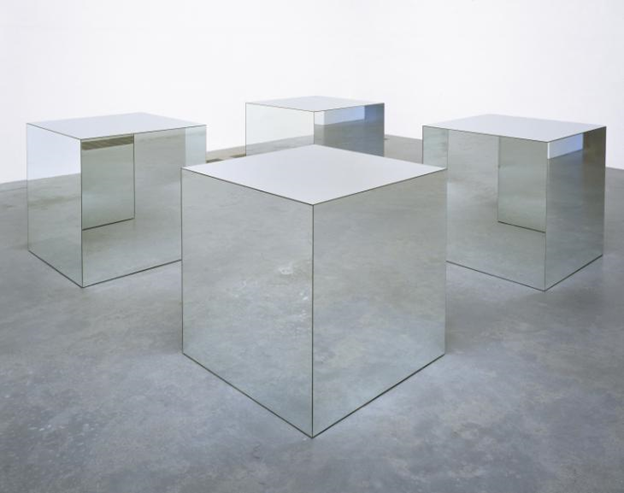
Untitled past Robert Morris 1965, reconstructed 1971
IMAGE SOURCE: The Tate Exhibit (Morris)
Emerging in the late 1950s, minimalism was developed as an extension of the abstract idea that fine art should not be an imitation, presentation or reflection but rather art should possess its ain reality. (Tate, n.d.). Minimalism aimed to be art of its purest form, arid of depictive content that aimed to defy outdated designs of craftsmanship.
Minimalism renounced excessiveness in symbolism and emotional content in favor of prioritizing the corporeality of the artwork made commonly from prefabricated industrial materials designed to be sleek, simple and often just geometric while doing away with the conventions of a normalized or widespread artful entreatment. (The Fine art Story, 2015)
Neo-Impressionism
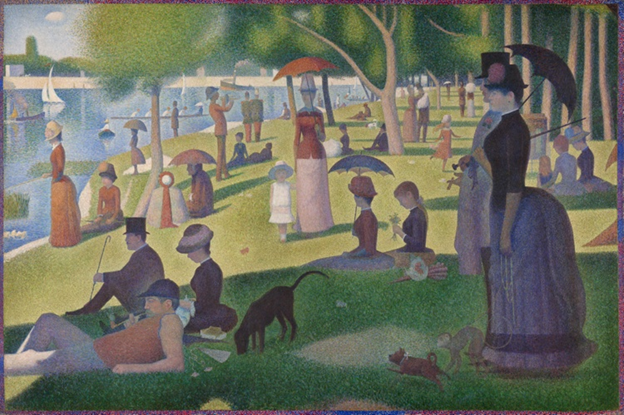
A Sun Afternoon on the Island of La Grande Jatte by Georges Seurat 1884
IMAGE SOURCE: Art Plant Chicago (Seurat)
Emerging mainly in France from 1886 to 1906, an advanced art motility known as Neo-Impressionism led by Georges Seurat and Paul Signac was founded. (MoMA, n.d.)
Neo-impressionism renounced the extemporaneity and romanticism of Impressionism in inclination to a methodical divisionism commonly simply erroneously called equally pointillism that placed tiny dots of colors on the sail which would mix and form images in the spectator'south eye. Neo-impressionism is based on optical color theories and the scientific studies of M-Eastward Chevreul (Tate, n.d.)
Neoclassicism
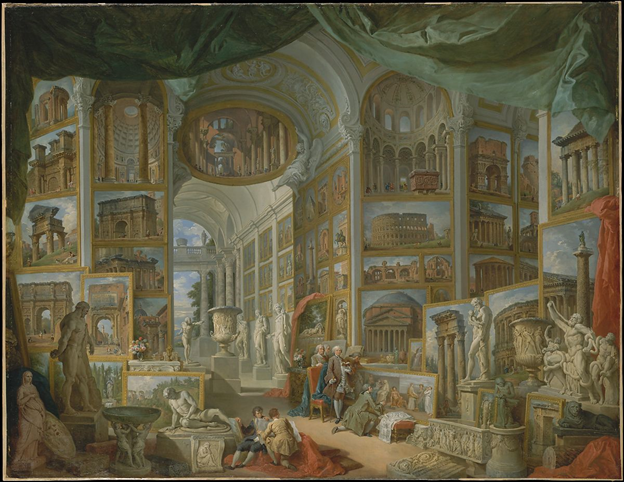
Aboriginal Rome by Giovanni Paolo Panini 1757
IMAGE SOURCE: The Met Museum (Panini, 1757)
Emerging around 1750 equally an unadulterated form of Classism, (Tate, north.d.) Neoclassicism was a move that was designed to retrieve the honors, splendors and magnificence of lost civilizations through visual arts (Gontar, 2003).
Neoclassicism is constructed on firsthand observation of historical and ancient Greek and Roman works that reigned Europe in painting, sculpture, decorative arts and compages. (MoMA, n.d.)
Performance Art
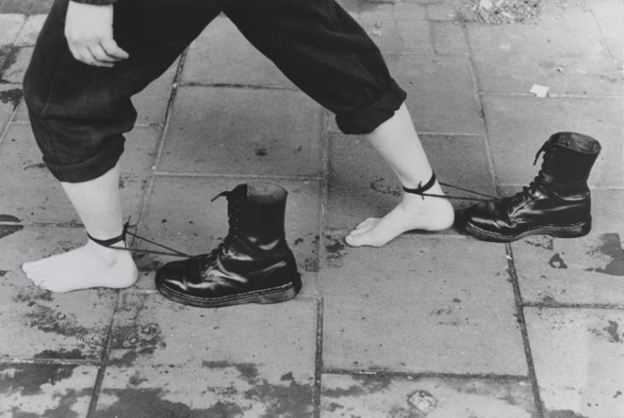
Performance Still by Mona Hatoum 1985, 1995
Paradigm SOURCE: The Tate Showroom (Hatoum, 1985)
Becoming a widespread term in the 1970s for the movement formerly known as 'trunk fine art', Performance or Operation Fine art is an anarchistic style of creating art that deviated from the usual static perpetuity of painting, sculpture and other stationary visual arts. (Tate, due north.d.)
Functioning Art is showcased live or pre-recorded and was produced through the concrete actions of artists, collaborators, performers or other contributors extemporaneously or rehearsed and planned. (The Art Story, n.d.)
Pop Art
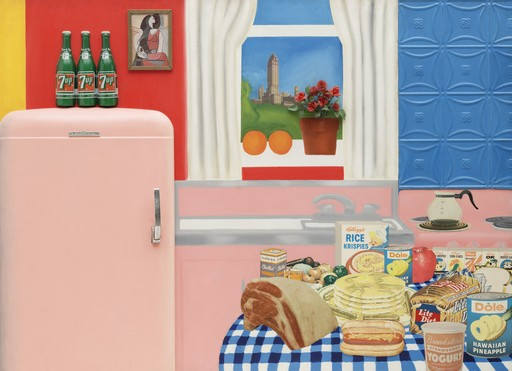
Still Life #thirty by Tom Wesselmann. April 1963
Prototype ART: The Museum of Mod Art (Wesselmann, 1963)
Emerging in the 1950s and booming in the 1960s Pop Art, primarily dominating America and Britain, consisted of fine art that drew influence from commercial and popular culture equally opposed to the Greco-Roman, philosophical, or conceptual inspirations of fine art (Tate, n.d.)
Pop Art emphasized the kitschy and common elements of everyday life in forms of large-calibration facsimiles, silkscreens that are mechanically reproduced and soft sculptures that transformed twenty-four hours-to-mean solar day items into a magnified scale amidst others. (The Art Story, 2016)
Post-Impressionism
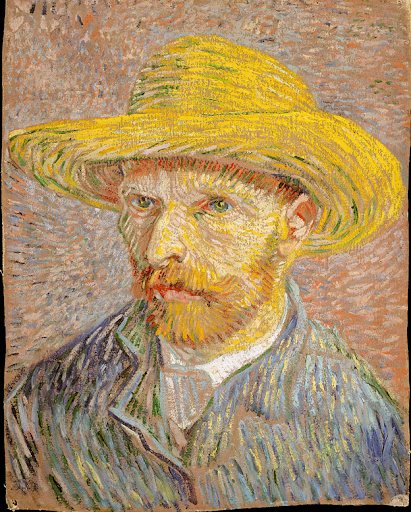
Self Portrait with a Straw Hat (obverse: The Potato Peeler) past Vincent van Gogh 1887\
Image SOURCE: The Met Museum (Gogh, Cocky-Portrait with a Straw Hat (obverse: The White potato Peeler), 1887)
First coined in 1910 by British art critic and painter Roger Fry, Post Impressionism was an extension of Impressionism developed in 4 particularly different directions by the artists Paul Cezanne, Paul Gauguin, Georges Seurat and Vincent van Gogh. (Tate, n.d.)
Post Impressionism sought to insubordinate against the true-to-life depiction of light and color limitations of Impressionism through a range of personal styles that supplied the emotional, operational, symbolic and spiritual elements that Post Impressionist artists felt Impressionism lacked. (Art Factory, n.d.)
Precisionism
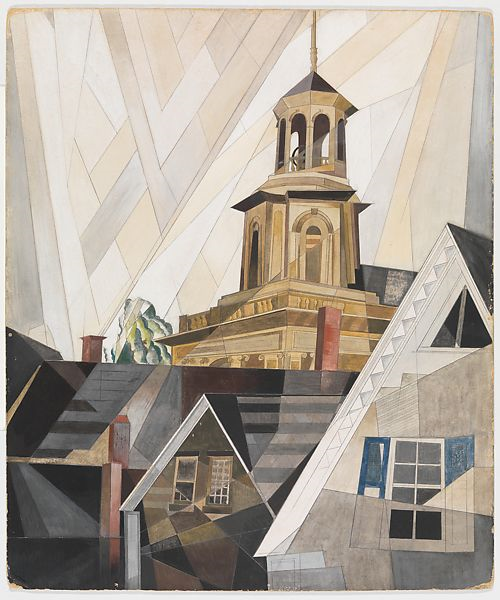
Later on Sir Christopher Wren by Charles Demuth 1920
Paradigm SOURCE: The Met Museum (Demuth, 1920)
Precisionists marked the dawn of America'south innovative industrial and scientific age through a visual translation of nonchalantly disconnected semi-abstractions that showed a united partiality to geometric forms that were further simplified and akin to the likes of Cubism and Futurism. (The Art Story, 2021).
Driven by the desire to bring structure back to art and celebrate the new American landscape of bridges, factories and skyscrapers, Precisionism experimented with an exceedingly detailed and meticulous approach to technique and form, often reducing compositions to elementary shapes and primary geometrical structures with minimal details, clear outlines and handling of surfaces done smoothly. (Murphy, 2007)
Rococo
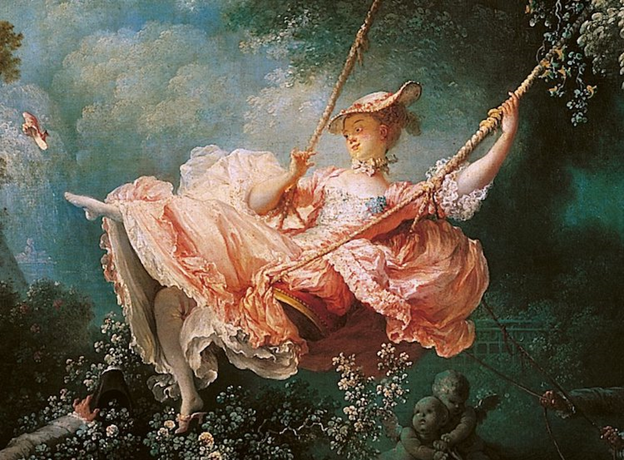
The Swing past Jean Honore Fragonard ca. 1766 – 1769
IMAGE SOURCE: My Modern Met (Fragonard, 1766)
Originating in France in the early 1700s (The Art Story, 2018), the term Rococo means "shell" or rock work created from the forms of corals and body of water shells derived from the French word rocaille (Tate, n.d.).
Rococo is occasionally referred to as the 'feminine' version of the Baroque art movement as it depicts aristocracy through gentle, often pastel colors that display tall and slender subjects who are besides sophisticated, fragile, refined and exquisite even down to the manner of their habiliment, activities and environs. (Sullivan, n.d.)
Rococo decorative art had an inclination towards embellishment and intricate detailing.
Surrealism
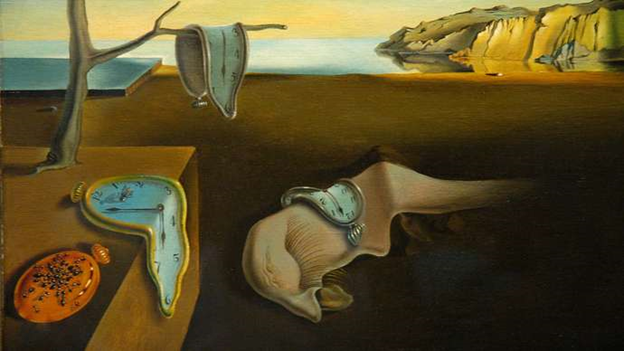
The Persistence of Retentivity by Salvador Dali 1931 | Prototype SOURCE: Britannica (Dali, 1931)
An art movement initiated in 1924 through Globe War 2 by the poet André Breton, Surrealism sought to intermission away from the rules of modern society that were considered oppressive past creating art that disregarded the rationality of thoughts through tapping into the "superior reality" of the subconscious mind. (MoMA Learning, northward.d.)
Surrealism favored the worth of dreams and the unconscious, finding beauty in the unforeseen and the eerie or uncanny.
Surrealism artworks championed the poetic, irrational and revolutionary through liberating thoughts, linguistic communication and human experience from the boundaries of rationalism past portraying psychological tensions that were hidden or trapped in a dream world similar state. (Tate, n.d.)
Suprematism
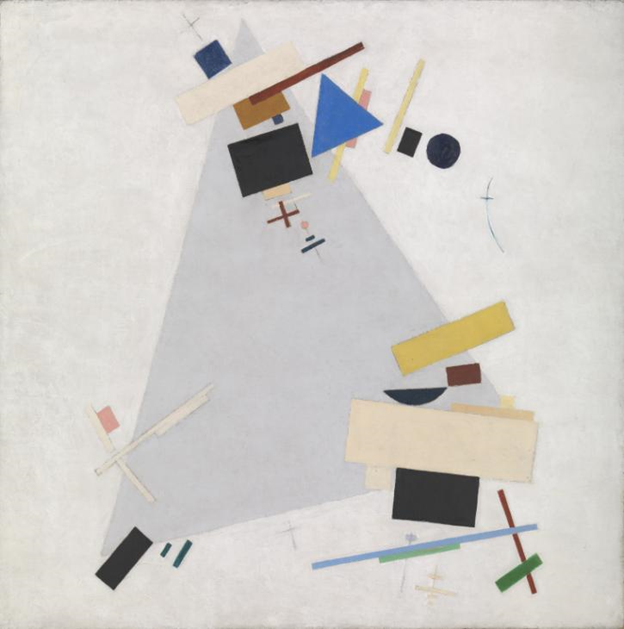
Dynamic Suprematism by Kazimir Malevich 1915 or 1916 | IMAGE SOURCE: The Tate Exhibit (Malevich, 1915 or 1916)
Named and founded in 1913 by the Russian artist Kazimir Malevich, Suprematism is characterized by beingness closely linked with the Revolution, using limited colour ranges in abstract compositions that would encapsulate simplified geometric shapes like squares, circles, triangles, rectangles and lines. (Tate, n.d.)
The principal belief behind Suprematism is that it would be superior to all other representational arts of the past as information technology would atomic number 82 to the "supremacy of pure feeling or perception in the pictorial arts."
Malevich was captivated by the quest of discovering fine art in its purest class, grounded on the belief that there were faint yet distinct links between words or signs and the objects of which they announce. (The Art Story, n.d.)
Symbolism
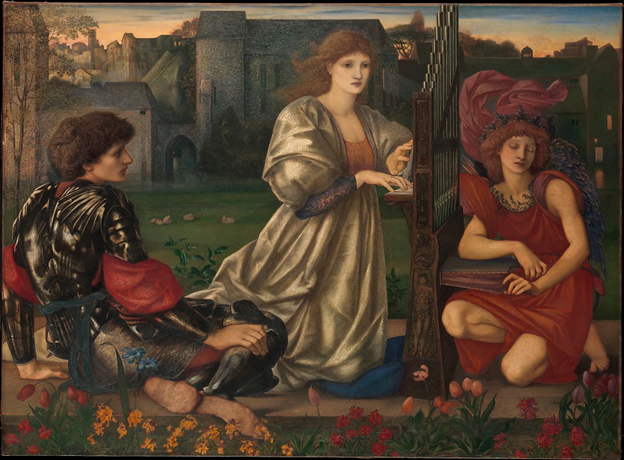
The Love Song by Sir Edward Burne Jones 1868 – 1877 | Image SOURCE: The Met Museum (Jones, 1868 – 1877)
Originally developed every bit a French literary motion in the 1880s, Symbolism is a term coined in 1886 past French critic Jean Moréas identified equally a fusion of expressivity of feelings, ideas, and the artists' introspective views of reality rather than representing the world in an objective, quasi-scientific way personified past Realism, Naturalism and Impressionism. (Myers, 2007)
Symbolism is a complex, idea provoking class of art that is able to arouse intellectual debate and is populated by mysterious and mythical figures derived from literature, the bible and Greek Mythology further fueled by psychological content focused on the erotic and mystical with common themes including: unrequited desire, sexual awakening, death, anguish, love and fright (Tate, n.d.)
Works Cited
Art Factory. (due north.d.). Post Impressionism. Retrieved from Art Factory Spider web site: https://www.artyfactory.com/art_appreciation/art_movements/post_impressionism.htm
Fine art History. (north.d.). Classicism. Retrieved from Art History Spider web site: http://www.arthistory.net/classicism/
Artland. (n.d.). Art Movement: Constructivism. Retrieved from Magazine Artland Spider web site: https://magazine.artland.com/fine art-motion-constructivism/
Beardsley, A. (northward.d.). Pattern for the Frontispiece to John Davidson's Plays . Art Nouveau. The Tate Showroom United kingdom of great britain and northern ireland, Uk.
Dali, S. (1931). The Persistence of Retentivity. The Met Museum. Retrieved from https://www.britannica.com/art/Surrealism
David, J.-L. (n.d.). Oath of the Horatii. Classicism. HiSoUR.
Demuth, C. (1920). Afterwards Sir Christopher Wren. Scan the Collection: After Sir Christopher Wren. The Met Museum. Retrieved from https://world wide web.metmuseum.org/art/collection/search/483297
Fragonard, J. H. (1766). The Swing. My Modern Met. Retrieved from https://mymodernmet.com/rococo-art/
Gogh, 5. v. (1887). Self-Portrait with a Straw Hat (obverse: The Potato Peeler). The Met Museum Scan the Drove. The Met Museum. Retrieved from https://www.metmuseum.org/fine art/collection/search/436532
Gogh, V. v. (n.d.). The Starry Night. History Archive. Shuttershock.com.
Gontar, C. (2003, October). The Heilbrunn Timeline of Art History Essay: Neoclassicism. Retrieved from The Met Museum Spider web site: https://world wide web.metmuseum.org/toah/hd/neoc_1/hd_neoc_1.htm
Hatoum, M. (1985). Functioning Nonetheless. Art Term: Performance Art. https://www.tate.org.uk/art/art-terms/p/performance-fine art.
Hausmann, R. (north.d.). The Art Critic. Dada. Tate, London.
HiSoUR. (n.d.). Classicism. Retrieved from HiSoUR Spider web site: https://world wide web.hisour.com/classicism-2981/
Jones, S. Eastward. (1868 – 1877). The Love Song. Browse the Drove: The Dear Song. The Met Museum. Retrieved from https://www.metmuseum.org/art/collection/search/435826
Kosuth, J. (due north.d.). One and Three Chairs. Fine art and Artists. The Modern Museum of Art MoMA.
Lipchitz, J. (n.d.). An Art Movement Overview: Summary of Cubism. An Art Movement Overview: Summary of Cubism. The Fine art Story. Retrieved from https://www.theartstory.org/motion/cubism/
Lissitzky, E. (north.d.). Proun (Project for Progress). Stedelijk van Abbemuseum, Eindhoven.
Malevich, K. (1915 or 1916). Dynamic Suprematism. Kazimir Malevich. Tate. Retrieved from https://world wide web.tate.org.united kingdom of great britain and northern ireland/art/artworks/malevich-dynamic-suprematism-t02319
Matisse, H. (northward.d.). Olive Trees at Collioure . Heilbrunn Timeline of Fine art History. The Met Museum.
Moholy-Nagy, L. (n.d.). Fotogramm. The Met Collection. The Met Museum .
MoMA. (northward.d.). Glossary of Art Terms. Retrieved from The Museum of Modernistic Fine art Learning Spider web site: https://world wide web.moma.org/learn/moma_learning/glossary/
MoMA Learning. (n.d.). Abstract Expressionism. Retrieved from The Museum of Modern Art Learning Web site: https://world wide web.moma.org/learn/moma_learning/themes/abstruse-expressionism/the-processes-and-materials-of-abstruse-expressionist-painting/
MoMA Learning. (n.d.). Conceptual Art. Retrieved from The Museum of Modern Art Learning Web site: https://world wide web.moma.org/acquire/moma_learning/themes/conceptual-fine art/
MoMA Learning. (northward.d.). Dada. Retrieved from The Museum of Modern Art Learning Web site: https://www.moma.org/learn/moma_learning/themes/dada/
MoMA Learning. (n.d.). Expressionism. Retrieved from The Museum of Modernistic Fine art Learning Web site: https://world wide web.moma.org/learn/moma_learning/themes/expressionism/
MoMA Learning. (due north.d.). Surrealism. Retrieved from The Museum of Modern Art Learning Web site: https://www.moma.org/learn/moma_learning/themes/surrealism/
MoMA. (northward.d.). Neo-Impressionism. Retrieved from The Museum of Modern Art Web site: https://www.moma.org/collection/terms/neo-impressionism
Morris, R. (n.d.). Untitled. Robert Morris. Tate.
Murphy, J. (2007, June). Heilbrunn Timeline of Art History Essays : Precisionism. Retrieved from The Met Museum Web site: https://www.metmuseum.org/toah/hd/prec/hd_prec.htm
Myers, Northward. (2007, August). Heilbrunn Timeline of Art History Essay: Symbolism. Retrieved from The Met Museum Web site: https://www.metmuseum.org/toah/hard disk drive/symb/hd_symb.htm
Panini, G. P. (1757). Ancient Rome. Browse the Drove. The Met Museum. Retrieved from https://www.metmuseum.org/fine art/collection/search/437244
Parker, C. (n.d.). Cold Dark Matter: An Exploded View. Tate.
Paul, S. (2004, Oct). Abstract Expressionism. Retrieved from The Met Museum Web site: https://world wide web.metmuseum.org/toah/hard disk drive/abex/hd_abex.htm
Pennsylvania Historical and Museum Commission. (n.d.). Art Deco Fashion. Retrieved from Pennsylvania Architectural Field Guide Web site: http://www.phmc.land.pa.us/portal/communities/architecture/styles/fine art-deco.html
Picasso, P. (due north.d.). Les Demoiselles d'Avignon. Pablo Picasso. The Mod Museum of Art MoMA, Paris.
Picasso, P. (n.d.). Weeping Adult female. Pablo Picasso. Tate. Retrieved from Tate.
Pissaro, C. (northward.d.). The Pork Butcher. Impressionism. Tate.
Pollock, J. (n.d.). Browse the Collection: Untitled. Retrieved from The Met Museum Web site: https://www.metmuseum.org/art/collection/search/482447
Samu, M. (2004, October). Impressionism: Art and Modernity. Retrieved from The Met Museum Web site: https://www.metmuseum.org/toah/hd/imml/hd_imml.htm
Seurat, G. (due north.d.). A Sun Afternoon on the Isle of La Grande Jatte. On View: Painting and Sculpture of Europe. Art Plant Chicago.
Severini, G. (due north.d.). Armored Railroad train in Activeness. The Museum of Modern Art, Mew York.
Smithson, R. (n.d.). Screw Jetty. Art 101: Land Art (Can You DIg It?). Art Infinite.
Postage, E. (2016, August 12). The Most Cute Art Nouveau Buildings Effectually the World. Retrieved from Architectural Digest Web site: https://www.architecturaldigest.com/gallery/the-most-beautiful-art-nouveau-buildings-around-the-world
Sullivan, G. A. (n.d.). Rococo Art. Retrieved from Bluffton Academy Web site: https://world wide web.bluffton.edu/courses/humanities/art/18c/rococo/
Tate. (due north.d.). Fine art Term: Fine art Deco. Retrieved from Tate Web site: https://www.tate.org.uk/art/art-terms/a/art-deco
Tate. (n.d.). Fine art Term: Avant-garde. Retrieved from Tate Web site: https://world wide web.tate.org.uk/art/art-terms/a/avant-garde
Tate. (north.d.). Art Term: Baroque. Retrieved from Tate Spider web site: https://www.tate.org.u.k./art/art-terms/b/baroque
Tate. (due north.d.). Art Term: Bauhaus. Retrieved from Tate Web site: https://world wide web.tate.org.uk/art/art-terms/b/bauhaus
Tate. (due north.d.). Art Term: Conceptual Fine art. Retrieved from Tate Web site: https://world wide web.tate.org.uk/fine art/art-terms/c/conceptual-fine art
Tate. (n.d.). Art Term: Cubism. Retrieved from Tate Web site: https://www.tate.org.britain/art/art-terms/c/cubism
Tate. (n.d.). Art Term: Dada. Retrieved from Tate Web site: https://www.tate.org.uk/art/art-terms/d/dada#:~:text=Dada%20was%20an%20art%20movement,satirical%20and%20nonsensical%20in%20nature
Tate. (north.d.). Art Term: Fauvism. Retrieved from Tate Spider web Site: https://www.tate.org.uk/art/fine art-terms/f/fauvism
Tate. (n.d.). Art Term: Futurism. Retrieved from Tate Web Site: https://www.tate.org.uk/art/art-terms/f/futurism
Tate. (n.d.). Art Term: Impressionism. Retrieved from Tate Kids Website: https://www.tate.org.uk/kids/explore/what-is/impressionism
Tate. (n.d.). Fine art Term: Installation Fine art. Retrieved from Tate Web Site: https://www.tate.org.uk/art/fine art-terms/i/installation-art
Tate. (n.d.). Fine art Term: Land Art. Retrieved from Tate Web site: https://www.tate.org.great britain/fine art/art-terms/l/land-art
Tate. (due north.d.). Fine art Term: Minimalism. Retrieved from Tate Web site: https://www.tate.org.united kingdom of great britain and northern ireland/art/art-terms/m/minimalism
Tate. (n.d.). Art Term: Neoclassicism. Retrieved from Tate Web site: https://www.tate.org.uk/fine art/art-terms/n/neoclassicism
Tate. (n.d.). Art Term: Neo-impressionism. Retrieved from Tate Spider web Site: https://www.tate.org.uk/art/art-terms/n/neo-impressionism
Tate. (n.d.). Art Term: Performance Fine art. Retrieved from Tate Web site: https://www.tate.org.uk/art/art-terms/p/functioning-fine art
Tate. (northward.d.). Art Term: Pop Art. Retrieved from Tate Spider web site: https://www.tate.org.uk/art/fine art-terms/p/pop-art
Tate. (north.d.). Art term: Post Impressionism. Retrieved from Tate Web site: https://world wide web.tate.org.uk/art/art-terms/p/post-impressionism
Tate. (n.d.). Art Term: Rococo. Retrieved from Tate Web site: https://world wide web.tate.org.united kingdom of great britain and northern ireland/fine art/fine art-terms/r/rococo
Tate. (n.d.). Art Term: Suprematism. Retrieved from Tate Web site: https://www.tate.org.uk/fine art/art-terms/s/suprematism
Tate. (n.d.). Fine art Term: Surrealism. Retrieved from Tate Web site: https://www.tate.org.united kingdom/art/art-terms/s/surrealism
Tate. (n.d.). Art Term: Symbolism. Retrieved from Tate Web site: https://www.tate.org.uk/fine art/fine art-terms/s/symbolism
Tate. (n.d.). Classicism. Retrieved from Tate: https://www.tate.org.united kingdom of great britain and northern ireland/art/fine art-terms/c/classicism
The Art Story. (2015, March 21). An Fine art Move Overview: Minimalism. Retrieved from The Art Story Web site: https://www.theartstory.org/move/minimalism/
The Art Story. (2016, January 21). Artists: Claes Oldenburg. Retrieved from The Art Story Web site: https://www.theartstory.org/artist/oldenburg-claes/
The Art Story. (2018, October 25). An Fine art Movement Overview: Rococo Movement Overview. Retrieved from The Art Story Web site: https://world wide web.theartstory.org/move/rococo/
The Art Story. (2021, March 25). Precisionist Motion Overview. Retrieved from The Art Story Spider web site: https://www.theartstory.org/motility/precisionism/
The Art Story. (n.d.). An Art Movement Overview: Earth Art. Retrieved from The Fine art Story Spider web site: https://www.theartstory.org/movement/earth-art/
The Art Story. (n.d.). An Art Motility Overview: Expressionism. Retrieved from The Fine art Story Web site: https://www.theartstory.org/movement/expressionism/
The Art Story. (n.d.). An Art Movement Overview: Fauvism . Retrieved from The Art Story Web site: https://www.theartstory.org/movement/fauvism/
The Art Story. (n.d.). An Art Motion Overview: Futurism. Retrieved from The Fine art Story Web site: https://www.theartstory.org/movement/futurism/
The Art Story. (northward.d.). An Art Movement Overview: Impressionism. Retrieved from The Fine art Story Web site: https://www.theartstory.org/movement/impressionism/
The Art Story. (n.d.). An Fine art Movement Overview: Installation Art. Retrieved from The Art Story Web site: https://www.theartstory.org/move/installation-art/
The Art Story. (n.d.). An Art Motion Overview: Suprematism. Retrieved from The Art Story Web site: https://www.theartstory.org/motility/suprematism/
The Fine art Story. (due north.d.). An Overview of Fine art Movements: Performance Art. Retrieved from The Art Story Web site: https://www.theartstory.org/movement/performance-art/
The Fine art Story. (northward.d.). Art Definition: Advanced Art. Retrieved from The Art Story Spider web site: https://world wide web.theartstory.org/definition/advanced/
The Fine art Story. (due north.d.). Fine art Movement Overview: Art Deco. Retrieved from The Art Story Spider web site: https://www.theartstory.org/movement/art-deco/
The Fine art Story. (n.d.). Art Movement Overview: Art Nouveau. Retrieved from The Art Story Web site: https://www.theartstory.org/movement/fine art-nouveau/
The Fine art Story. (due north.d.). Art Movement Overview: Baroque Art and Compages. Retrieved from The Art Story Web site: https://www.theartstory.org/motion/baroque-art-and-architecture/
Thornhill, J. (due north.d.). The Embodiment of Romulus. The Apotheosis of Romulus: Sketch for a Ceiling Decoration, Perhaps for Hewell Grange, Worcestershire. Tate.
Tyrtov, R. P. (n.d.). Costume pour Le Triomphe de la femme. Erté: an Art Deco Genius. Render to St Petersburg. The Land Hermitage Museum, St. Petersburg, Russia.
Wesselmann, T. (1963, April). Still Life #xxx. Art and artists: Pop Fine art. The Museum of Modern Art. Retrieved from https://www.moma.org/collection/terms/pop-art
Winton, A. G. (2007, Oct). The Bauhaus, 1919–1933. Retrieved from The Met Museum Web site: https://www.metmuseum.org/toah/hard disk/bauh/hd_bauh.htm
Source: https://stylewithinreach.net/types-of-art-styles
0 Response to "Murphy Jessica Heilbrunn Timeline of Art History the Mets Heilbrunn Timeline of Art"
Postar um comentário